 English
 English
Get the full Irramax Field Research Report: five paired-plot field trials in Florida, Texas and Nebraska. In each one, Irramax-treated soil held more water than grower standard practice, from +17% to +284% depending on crop, site, and depth.
Every irrigation decision comes down to one question: how long will the water stay where the roots can use it? We tested Irramax against growers' standard practice across different soils, climates, and crop water demands to see whether its moisture-retention effect holds up in the field.
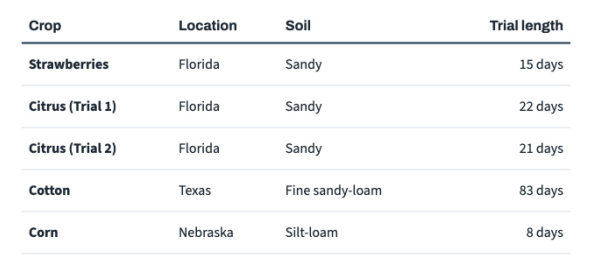
It did. The advantage showed up on sandy Florida soils, in semi-arid Texas fine sandy loam, and in Nebraska silt loam, in trials lasting from 8 to 83 days.
"(Required)" indicates required fields
more soil moisture than GSP, by trial and depth
4 crops, 3 states, 3 growing seasons
longest trial; IRRAMAX read wetter every day
less salinity volatility was measured
Every irrigation decision comes down to one question: how long will the water stay where the roots can use it? We tested IRRAMAX against grower standard practice across different soils, climates and crop water demands to see whether its moisture-retention effect holds up in the field.
It did. The advantage showed up on sandy Florida soils, in semi-arid Texas fine sandy-loam and in Nebraska silt-loam, in trials lasting from 8 to 83 days
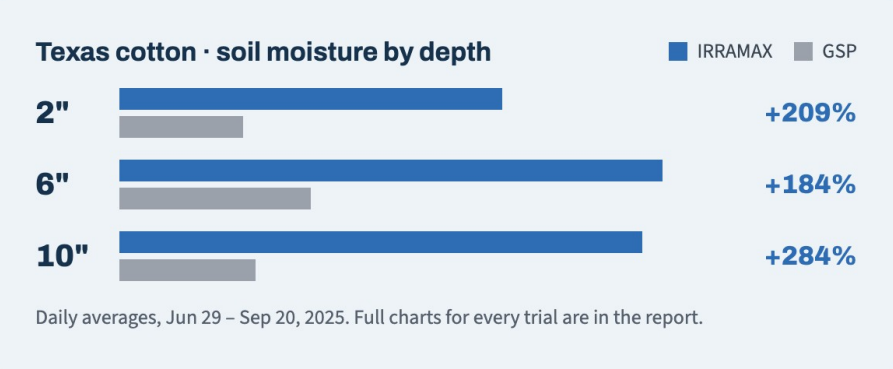
Full moisture data for strawberries, citrus (two trials), cotton, and corn, broken out by sensor depth.
Daily-average data from Sentek capacitance probes logging every 15 minutes.
In Texas cotton the advantage peaked at 6 and 10 inches, where crop roots do most of their work.
Lead researcher David Lankford's interpretation of the probe data from each site.
In citrus and cotton, Irramax plots held lower, steadier salinity; GSP was 3 to 5 times more volatile.
What the results mean for scheduling, deficit irrigation, and sensor placement.
Each site paired an IRRAMAX-treated plot with an untreated check plot in the same soil and irrigation zone. Every plot used the same Sentek probe platform and factory calibration, so results compare directly across sites.
Raw readings were processed into standardized daily averages and compared depth by depth

David Lankford, Research Director, agriMeasures LLC.
Irramax is a polymer-based irrigation enhancer from Corbet Scientific that helps soil hold water in the crop root zone.
Each trial compared Irramax-treated plots with untreated check plots managed under the grower standard practice (GSP) in the same soil-irrigation depth.
Sentek capacitance probes log every 15 minutes at multiple depths. Every site used the same platform and calibration.
Soil type, climate, crop, and trial length all differ by site. Percentages also run higher where untreated moisture levels were low, so the report gives absolute vol% differences alongside the percentages.


